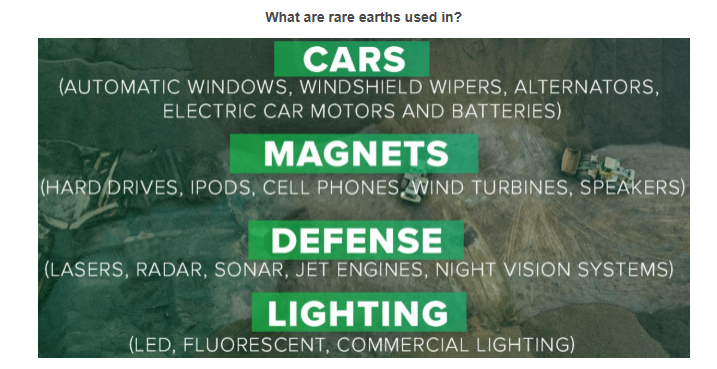
Rare earths and critical minerals - what are they?
Perhaps the first question to ask about rare earth elements (REE) and critical minerals is what are they are and where they are? The US Geological Survey identifies around 50 “critical materials” judged to be essential for renewable energy projects, defence systems, and advanced manufacturing. REEs are a sub-set of this bigger group which are also used in applications such as mobile phones and wind turbines. Critical minerals also include lithium, copper, and nickel.
Rare earths themselves are a distinct set of 17 silvery-white and soft heavy metals. The REE label is normally applied to a main group known as lanthanides, plus scandium and yttrium. There are an estimated 110m tonnes of REEs in the Earth’s crust. Compounds containing REEs have a range of applications in electronics, lasers, semi-conductors, magnetic materials, and industrial processes. Gadolinium is used in nuclear power reactors, scandium in vehicle fuel cells, and neodymium in magnets. REEs are distinct from critical minerals although there is also a category known as “rare earth minerals” which are minerals that contain one or more rare earths.
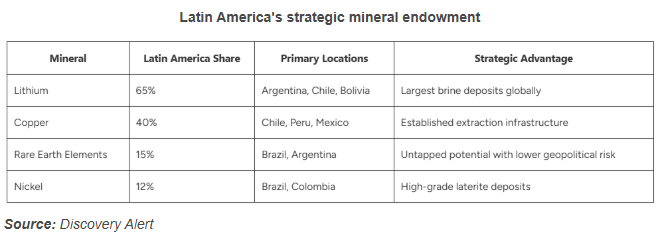
Geologists say the term rare earths is actually a misnomer since these metals are not actually scarce. They are rare however in the sense that they are only found in chemical compounds and are difficult to isolate and purify. Doing so requires processing large volumes of raw ore which is costly and energy intensive. It is also worth noting that REES are sometimes found in association with radioactive mining materials such as thorium and uranium.
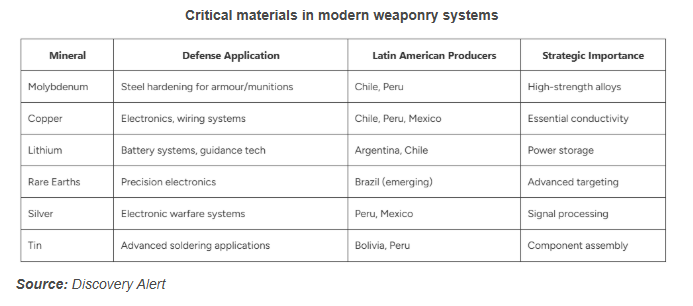
Military applications of REEs are closely watched because of their direct role in the performance and cost of advanced weapons systems. It is estimated that a single advanced jet fighter requires over two tons of copper for its electrical systems. REEs are also key to the functioning of precision-guided munitions. Researchers say that typically there is an 18-month lag between the outbreak of military conflict and procurement increases. Molybdenum demand for steel defence systems typically spikes 40%-60% above normal during the 24-36 months following the outbreak of an armed conflict. Electronic warfare systems have created new demand for REE. Electronic components now represent 30%-40% of total material costs of defence systems, up from 15% traditionally. It is therefore possible that the current wars in the Middle East may step up demand for Latin American minerals.