
Where are they?
The global distribution of REEs and critical minerals – an accident of nature and geology - has been favourable to Latin America. The region is believed to control 65% of global lithium reserves, 40% of global copper deposits, and around 15% of REEs. In Argentina alone the assessment of lithium reserves has increased by a potential 40% thanks to recent geological exploration. Latin American countries with significant REE and critical minerals reserves include Brazil, Bolivia, Chile, Peru, and Argentina.
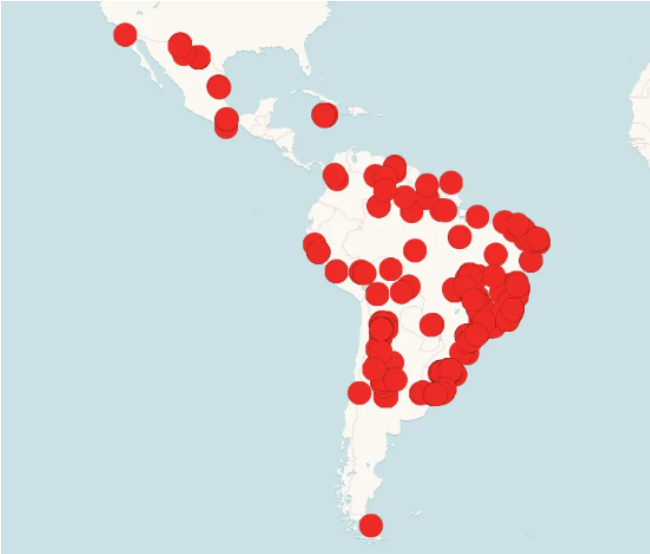
Source: Newsweek. Based on U.S. Geological Survey data
The ratio of reserves to extractive capacity is also interesting and suggests there is room for serious output growth. Chile, a country with well-developed mining expertise built up over decades, is extracting a relatively modest 180,000 tonnes of lithium a year from reserves of 9m tons. Neighbouring Bolivia, with much less expertise in extractive capacity, is sitting on reserves of 21m tonnes.
While Latin America has its share of political risk and volatility, some mining analysts argue that it is comparably more stable than some locations in Africa and Asia. In the contrast to the current Middle East conflict, Latin American REE and critical minerals can be shipped directly without hindrance to North American and European markets , either through Pacific or Atlantic shipping routes. Important mineral-rich clusters give producers negotiating leverage. Forty-five per cent of known global lithium reserves are to be found in the lithium triangle that straddles Argentina, Bolivia, and Chile. Chile and Peru together are responsible for 30% of global copper output.
Top 10 countries for global rare earth reserves
In million tonnes, 2025
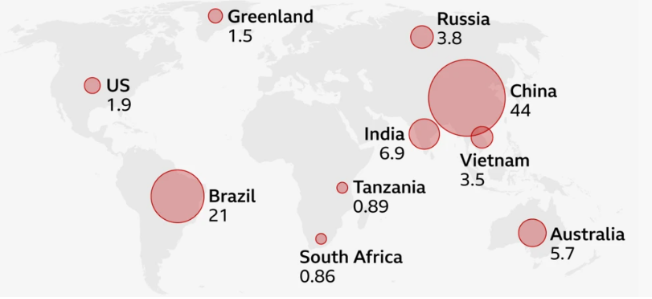
Source: BBC
Another Latin American location advantage is that mining projects in the region require as much as 18-24 months less development time than those in other countries before they come onstream (although producers still complain of red tape and bureaucracy).